Laterally thinking …

I listened to a book (or half, anyway) the other day by Edward de Bono called Lateral Thinking: Creativity Step by Step. It was a bit old-fashioned, having been written in the 1970s (crickey, I must be positively antique), and was really aimed at educators and teachers. It was still an interesting look at the type of thinking we are often taught, and the ‘other’ option.

The two types of thinking de Bono talks about are vertical thinking and lateral thinking. He posits that education focuses primarily on vertical thinking (although, I think in the last 40 years this has changed somewhat) which is the seeking or learning of knowledge along a logical line where each step is built on the one before. Lateral thinking is following a more sideways path of seemingly unrelated thoughts that can then, perhaps, be connected.

His useful visual image is that vertical thinking is akin to digging a particular hole deeper and deeper to reveal more of the treasure down there. De Bono stresses that this is vital thinking and that his promotion of alternatives in no way lessens its importance. Lateral thinking, on the other hand, is like digging a range of shallower holes across an area to see what might be uncovered that way. Further, I tentatively add my own image – that creativity is seeing possible ways that these many holes can be connected by unexpected tunnels.

I’m taking a couple of weeks’ holiday from painting to go on a road trip but it seems to me that my swirling thoughts over the many miles of road ahead can still strive for lateral-ness! In fact, it’s probably a good opportunity with new sights and experiences to set me off. Lots of ground, lots of shovels, lots of holes I hope.

I’ll keep you posted.

Kirsten
A question of quantity, not quality

Sometimes you hear something that turns your thinking upside down.

We are often told that ‘it’s quality, not quantity’ that matters. There are many reasons for, and innumerable applications of, this aphorism. It is what leads to excellence in all sorts of fields.

I was listening to The Inspiration Podcast by artist, Miriam Schulman. Her guest was Alyson Stanfield, artist, artistic business coach and author. Her view of the quality/quantity question, for creatives anyway, offered a new perspective.

As artists, only a percentage of our works are successful. It is unrealistic to think that everything we produce is joy-worthy or sale-worthy . I don’t know what that percentage is: I guess it differs for each practitioner (when I was writing poetry, the rate I worked on was one in eight to ten). The implication is that to produce a body of work of which we can be proud, we need to paint significantly more than the number required to achieve our goal. Additionally, when one breaks it down into bottom-line financial terms, the results indicate that there needs to be a fair bit of creating going on.

But it’s not only about the numbers. It is only through quantity, says Stanfield, that we achieve quality. By stretching and strengthening our creative muscle regularly we constantly improve our practice and move beyond that portion of our output that is less that we’d hoped. We need to ‘allow ourselves to suck’ in order to make progress and experience the results we desire.

So it makes me think that I don’t really have time to be wallowing about in this cafe! Haha! Onward!

Until later,

Kirsten

Leap or step?

I am thinking of making an approach to an outlet. There are three ways it could go; it could be unsuccessful, which is fine; it could be successful, which is also fine; or it could be successful and change the way I view the work I’m doing, which may be fine or may definitely not be. A conundrum.

So then a podcast episode by artist Miriam Schulman cropped up where she talked about not feeling ready. Do we ever feel really ready, she questioned. Was this part of the ‘take the leap and grow wings on the way down’ type of approach? It sounded exciting and something that, on those good days, would be eminently do-able or even must do-able! I was amused that such an episode should air at just the right time. I smiled!

Following that, in a completely unrelated place, I read that research indicates we learn best from a position of knowledge from where we take deliberate steps. We build on our previous learning a piece at a time. I rolled my eyes that such a paragraph should come along at just the same time. I smiled, wryly this time.

Back to the conundrum. Back to weighing up the risk in the decision.

I haven’t solved anything yet. Still thinking. Sorry to leave you hanging!!

Until later,

Kirsten

That great finger from the sky

I waited for a long time for that great finger from the sky to come down, through the clouds, touch me on the forehead and label me an artist. I would then be allowed to use the term to describe myself because it had been officially deemed by a higher authority who knew about these things.

Of course, I realised that it was actually up to me. I was the one who had to decide on that descriptor and then, shoving down the fear, live up to it. It still took some time – business cards printed without ‘artist’, sticking with the no-longer-fully-accurate identity for safety and some sort of over-pedantic ‘honesty’.

But eventually I wanted to try it out. I filled in the blank on a form at the dentist first. Occupation: artist. The well-known imposter syndrome kicked in and I almost crossed it out. Only almost. For better or worse, a business in Unley, Adelaide, has me forever listed as a person of creativity.

After some time of writing the word, I tried it out verbally – qualified at first with phrases such as ‘just part time’, ‘only amateur’, ‘not really making a living’. Now, after a number of years, I can use the term and not feel quite so much like I’m aged five, clunking around in front of a mirror wearing mum’s best shoes and glamorous shawl.

But, underlying all this is the reality that the best way to be something is to do it. Labels are, after all, meaningless if there is no action behind them. Don’t waste time waiting for the great finger from the sky. Make it irrefutable by your practice.

Until later,

Kirsten

So here’s a great concept

The Adjacent Possible

In 2002 Stuart Kauffman, theoretical biologist who studies the development and evolution of organisms, introduced the idea of the adjacent possible, this being the range of options that exist from a given (and ultimately shifting) point. His idea was ‘…it just may be the case that biospheres on average keep expanding into the adjacent possible. By doing so they increase the diversity of what can happen next.’ (Edge.org) If you like, it’s similar to the idea of a room with multiple doors, each one leading to a new room with a new range of doors that weren’t accessible from the initial location.

Nancy Hillis takes up this notion in her book The Artist’s Journey. She says ‘the act of moving forward creates a new set of steps that would have been difficult or impossible to predict beforehand.’

There seems to be an absolute treasure trove of thinking and working applications of the adjacent possible. It’s a bit mind-boggling.

The adjacent possible. I love it.

Kirsten

Solving problems

During one of my recent long-distance drives I was listening to a interview with writer and marketing guru, Seth Godin. Although not what you could call my pet area (!!), it was interesting and gave me food for thought.

Seth’s basic tenet is that, through marketing, we are solving a problem that our customer (what a horrendous word in my context!) has. This is, I guess, the basis of the advertising that we see everywhere. So, if we’re solving a problem that buyers have, what problems do MY buyers have that might prompt them to purchase what is, essentially, the most discretionary of items?

Perhaps they need a gift for someone. Perhaps they have a blank wall and have been looking for something to fill it. Generally though (but I could be completely wrong here), I think often buyers don’t have a problem they are trying to solve until they see a work that they simply must have. That then becomes the problem and the solution is, unexpectedly, in front of them.

So what does that mean for me and my practice? Well, I’m not sure that it would essentially change what I plug away at. My experience is that it is impossible to predict what people will love so it would be foolish at best, and inauthentic (for me) at worst, to try to create specifically for a market – in my type of work, anyway (it works for some people, and that’s great).

And now, as a result of all that, I think about each thing that I buy (even milk!!) with new insight!

Until later,

Kirsten

My painting is an introvert

I do a bit of thinking and reading about introversion and extroversion – the particular ways that people operate, the value society places on extroversion, how different approaches are effective with each person given their placement on the continuum.

It occurred to me that some paintings are definitely extroverts – bright, bold, calling to the viewer to ‘look at me!’, communicating their message with confidence and lack of apology. They are some of the magnificent paintings we remember or that we notice first in an exhibition.

The logical progression here was to consider how a painting might function as an introvert. They would be the subtler works, the ones that take a little more looking, the ones that we come to on our second tour of the collection. They are no more or less important or valuable, just different and, like in humans, there must be some sort of continuous line along which each work places itself.

Or does the artist place them? I am still working with my piece that was a little too subtle. It is destined for a competition where finalists are selected from digital images and it seems to me that, unless the image stands out from the myriad paintings submitted, it will be passed over immediately. To what degree do I need to manipulate the extroversion or introversion of my work to be noticed?

No doubt it all depends on the judges – a completely unknown and uncontrollable quantity – but I am suspecting that I need to take my introverted painting at least a little toward the middle of the spectrum.

So, here’s to a bit of splashing around colour today!

Kirsten

A bit too subtle

One of my current works in progress is of a stand of trees, developing in a style somewhere between realism and abstract. I’m liking it at the moment and have sort of been sneaking up on forms and washes of colour that please me.

I have decided, though, on looking at it this morning, that it’s a little too subtle. There’s no need to blast the viewer out of the gallery, but there needs to be some impact in a work from whatever source it, or the artist, has chosen.

There are other words I could have selected to describe it thus far. Wan. Wimpy. Washed out, boring, unnoticeable. Even unsatisfying or dull. But, I have chosen to focus on it being a ‘little too subtle‘. Kinder, somehow. And perhaps easier to remedy when I come to it later today.

I guess, it’s all about how you frame it.

Kirsten

Accountabilibuddy

It doesn’t really matter whether I do my creative work today. It probably doesn’t really matter whether I do it tomorrow either, or the day after. As long as I meet any deadlines, and there aren’t many of those, I can drift along with few consequences. I’m not saying I LIKE that state, AT ALL (capitals AND underlining!). It’s certainly not one that inspires the soul. It does happen, though.

Maybe you’re the same with your creative work, or any other thing of importance for you that you undertake. It is very easy to let it waft about or get left behind when no-one is looking over your shoulder.

And that’s why Cat Rose, in her book The Creative Introvert …, talks about accountability. Sounds like a serious word. But, in a gentle twist, she suggests enlisting the assistance of an “accountabilibuddy”: someone to, literally, hold you to account who also fits into the role of a buddy – a friend, supporter, fellow creative or whoever. Maybe you could find someone and be mutual accountabilibuddies.

I must confess, I do just like saying the word – accountabilibuddy. It rolls off the tongue beautifully! But, like all the good words, it also contains a great idea. It’s a bit scary, suddenly leaping into being held to account, even in the most undemanding of ways, but maybe even the expectation of reporting in on, say, ten minutes, three times a week (or whatever suits your situation) is enough to get us all started. And, as we know, once we get started amazing things can happen!

Here’s to buddies.

Kirsten

Lightness

I am in Melbourne at the moment and took today to go to the National Gallery of Victoria and see the Alexander Calder exhibition. An American artist, Calder was born around the turn of the 20th century. His work is greatly varied – sculpture, drawing, painting, jewellery – but it is for inventing the hanging mobile that he is best remembered.

And I was entranced by those mobiles. The more delicate the better. Pictures in books had conveyed, as always, a poor representation of their real beauty. Their balance, their floating presence and their (very) gentle movement in the air of the gallery made me want to take each one home and hang it in a suitable vantage point in my home (although, it would probably need a new, dedicated wing to adequately house such glorious things).

They looked so light and were, quite literally, free of the earth. It made me ponder lightness. In my singing days I had a voice that was firmly grounded in the warmth of the soil (and, certainly, there are delights that come with that) but I used to marvel at the voices that seemed to break free of gravity and soar, unfettered. They had a lightness that my dark tones couldn’t replicate. It is those trees with narrow leaves, with subtlety, that attract me most. That delicate word in a poem, a fine piece of jewellery, the faint hint of detail in a drawing, are things that move me.

At the moment I am painting a solid piece – a large, bold, abstract exploration of rocks and caves – but I am now wondering how to incorporate a lightness into it, how to lift it beyond its earthly subject matter and add that piece of magic. How can I make it soar, gravity-free?

That’s my challenge for the week.

Until later,

Kirsten

The workplace

I have been spending a lot of time with people who work in offices. All of them strive to schedule regular days of working from home, expressly to ‘get something done’.

When, and why, did the workplace become the least efficient place to actually do work?

Kirsten

The minimum

Heard some interesting things recently. Made me think.

In a podcast by my anti-procrastination guru, David Kadavy (mentioned in earlier posts), he touched on the medical term of Minimum Effective Dose – that being the smallest amount of treatment that will elicit a positive response in a patient. He then went on to introduce the idea of Minimum Creative Dose – that being the smallest amount of creative ‘beginning’ required to engage ones natural creative momentum that will cut in (hopefully like some torrential waterfall!!) and carry you on. Just get started, he reasons, and the love of what you do, the intellectual enjoyment, the rise of ideas will arrive (only slightly late) and join the party.

Then, in another podcast, totally unrelated to the first, Seth Godin, author and marketing expert, talked about Smallest Viable Audience. His idea was that we sometimes feel we have to conquer, connect with, market to, the whole world. In reality, we simply need to communicate with enough people to keep us rolling along. “Blow them away and they will tell their friends”, he says. Thus, our connections will grow. Of course, this is all related to marketing which, as you know, is NOT my happy place …. but somehow that idea takes the pressure off.

And so, I will dive into a new week with a new resistance-decreasing technique and a need-for-wider-marketing avoidance tip (I’m sure that’s not what Godin intended!!). I hope any creative endeavours (indeed, ANY endeavours) you tackle this week can perhaps benefit as well.

Best wishes,

Kirsten

Highlights

I recently saw the Ben Quilty exhibition at the Art Gallery of South Australia. It was a real mix of his work from early years, through his time as the war artist for Australia and other pieces including his Archibald-winning painting of Margaret Olley.

I was particularly taken by the way that the lightest areas in many of the works were left unpainted; the white canvas providing, what we call in the art world, the highlights. More commonly, in oil and acrylic painting, these highlights would be added with light-coloured paint. Instead, Quilty had left NO paint, more akin to the preservation of the white of the paper that consumes watercolour artists. I loved it.

It made me think about the times in our lives that we call highlights. Maybe these are the uncluttered times, not confused with other layers? Perhaps they are the pure experience, stripped back and with a similar clarity to the blank canvas. Could we create more of these times by avoiding the extra ‘noise’ that tends to crowd so much of what we do? My thinking challenge for the day!

Until later,

Kirsten

Umming and ahhing

I have been umming and ahhing about whether to publish this post. I’d hate ANYONE to think I was getting preachy, or trying to influence how people should live their life.

I need to remember that the purpose of this blog is, firstly, for me to clarify my thoughts, perhaps for myself as much as anything else. If others are interested that is a enormous win for me. So, please forgive me a little bit of self-indulgence.

I have been reading a book called The Creative Introvert: How to build a business you love (on your terms) by Cat Rose. I am, of course, ridiculously pathetic at anything to do with promotion so I thought maybe this book might help. I must confess that, once it got to the marketing chapters, notwithstanding their definite understanding of salesmanship-phobia, I did get uncomfortable (maybe a bit of skimming involved). But there were many other things that I got out of it (don’t worry! I won’t go through all of them!!).

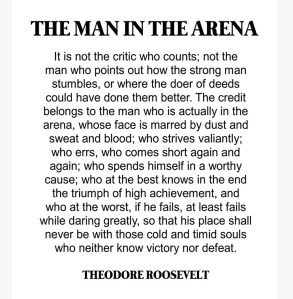
I was reminded of a quote by Theodore Roosevelt that was recently brought back into the collective consciousness by writer, speaker and researcher Brene Brown – commonly called the ‘man in the arena’ quote. It’s a bit long but I will include it here as it’s always good for me to read it again.

Brene Brown, in her book Rising Strong, pulls out of this the need to SHOW UP, to be in the arena doing our thing. There may be critics but, as she says, ” … if you are not in the arena and also getting your arse kicked, I am not interested in your feedback.”

I don’t really know yet what all of that means for me but there’s lots to think about. I think it’s suggesting that I keep plugging away (I am very fortunate that there is not a great deal of arse-kicking at the moment!!) even when it gets hard or discouraging. I need to ‘show up’ more often.

But remember, that’s just me talking to myself!

Kirsten

Coming home

I picked up some paintings yesterday from a place where they had been exhibited for a while. I had been lucky enough to sell a few from that location so it had obviously been a successful venue. I realised, though, on approaching the door, that I felt nervous about seeing the works remaining. How would I feel about them after not seeing them for a while? Would I be pleasantly surprised? Would I feel mildly critical having had some distance or would I feel a bit embarrassed that I could ever think that they were worthy of display?

Actually, my first and strongest response was one of fondness, and then pleasure at being able to gather these things of mine back into their folders and sneak them away with me. It made me think that even a small display, like a performance, requires energy and, much as we love it, it suddenly becomes nice to collect the troops and retreat together for a moment, to take a breath, take stock.

There are other artworks going out to various shows and competitions so it’s not as if the whole enterprise has ground to a halt. It was just that nice feeling of getting some of the family back together and sitting around for a drink behind the stage.

So, sit around today and enjoy the company of your art, whatever that may be.

Until later,

Kirsten